Activity
Control & Back
Skill: Specialised Sports Coaching
Sports: Football
Technique: Ball Control
Class: Class 4
Skill: Specialised Sports Coaching
Sports: Football
Technique: Ball Control
Class: Class 5
Skill: Specialised Sports Coaching
Sports: Football
Technique: Ball Control
Class: Class 6
Skill: Specialised Sports Coaching
Sports: Football
Technique: Ball Control
Class: Class 7
Skill: Specialised Sports Coaching
Sports: Football
Technique: Ball Control
Class: Class 8
Skill: Specialised Sports Coaching
Sports: Football
Technique: Ball Control
Class: Class 9
Skill: Specialised Sports Coaching
Sports: Football
Technique: Ball Control
Class: Class 10
Skill: Specialised Sports Coaching
Sports: Football
Technique: Ball Control
Class: Class 11
Skill: Specialised Sports Coaching
Sports: Football
Technique: Ball Control
Class: Class 12
Skill: Specialised Sports Coaching
Sports: Football
Technique: Ball Control
Control & Back
Learning Outcomes
Improve first touch to control a rolling or passed ball.
Develop accuracy in passing the ball backward with the inside of the foot.
Enhance awareness of space and teammate's position.
Improve reaction time and coordination.
Reinforce the importance of a controlled second action after receiving.
Description Of Activity
Create a rectangular grid (e.g., 5x5 yards or adjust based on player age and skill).
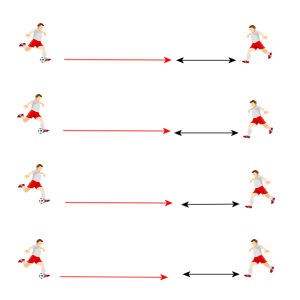
Players work in pairs. One player starts inside the grid with a ball, and the other starts just outside one of the shorter sides of the grid.
Initiation: The player outside the grid gently rolls or passes the ball into the grid for their partner.
Control: The player inside the grid takes one controlled touch to stop or redirect the ball within the grid. They should aim for a positive first touch that keeps the ball close and under control.
Backward Pass: Immediately after their first touch, the player inside the grid plays a controlled pass backward with the inside of their foot to their partner outside the grid.
Rotation (Optional): After passing, the player who was inside the grid can move to the outside, and the player who passed the ball in moves inside. This keeps players actively involved. Alternatively, players can stay in their initial positions for a set number of repetitions.
Increase the speed of the pass/roll: This challenges the receiver's reaction time and control.
Vary the type of pass: Use lofted passes or passes with slight spin to make control more challenging.
Introduce a defender (passive initially): A third player can stand inside the grid and lightly pressure the receiver, forcing quicker decisions and better control.
Add a target to pass to: Instead of just passing back to the feeder, the receiver controls and passes to a different target (e.g., a cone or another player).
Limit the space: Reduce the size of the grid to increase the pressure and require tighter control.
Two-touch control and pass: Allow players two touches to control the ball before making the backward pass. This can be a good starting point for beginners.
Variations
Directional First Touch: Encourage players to control the ball with their first touch in a specific direction before passing back.
Using Different Parts of the Foot for Control: Instruct players to use different parts of their foot (inside, outside, sole) for the first touch.
Control and Volley Back: For more advanced players, after controlling the ball, they can volley the pass back instead of a ground pass.
Timed Rounds: Make it a competition by timing how many successful control and back passes each pair can complete in a set time.
Coaching Tips

Emphasize the first touch: The quality of the first touch dictates the ease of the backward pass. Encourage players to take the ball away from pressure and into a comfortable passing position.
Focus on the passing technique: Stress the importance of using the inside of the foot for accuracy and control in the backward pass. Encourage a firm ankle and a controlled swing.
Encourage quick reactions: Players should be on their toes and ready to react to the incoming ball.
Promote awareness: Players inside the grid should scan and be aware of their partner's position before and after controlling the ball.
Stress controlled movement: Avoid wild or unnecessary movements. Focus on efficient and controlled actions.
Provide feedback: Offer constructive criticism on both the control and the pass.
Make it game-realistic: Explain how this drill relates to receiving a pass in a game and playing a simple pass to maintain possession or switch play.
Equipment/Material Required
Football, Cone